What Is a Turnbuckle? Different Types and Options

The rigging and industrial hardware industries rely on various unique pieces of rigging hardware that aren’t actually that versatile. Instead, their applications are pretty specialized. One such piece of hardware is the turnbuckle.
A turnbuckle is a simple piece of rigging hardware that can be used in a diverse set of tension-related applications. In other words, it’s rigging hardware used to adjust the tension and reduce slack in various tensioning assemblies. In this article, we’ll discuss turnbuckles and their different types.
Working Mechanism of Turnbuckles
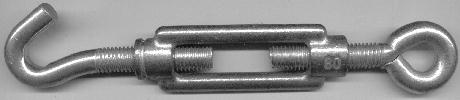
Turnbuckles, also known as stretching screws or bottlescrews, usually consist of two threaded eye bolts, each fastened into an end of a small steel frame, with one of those threads being left-handed while the other is right-hand threaded.
As they’re mostly used in rigging applications with cables and wire ropes, the tension is adjusted by rotating the turnbuckle’s frame, which actually causes both threaded bolts to screw in or out simultaneously without twisting the attached ropes or cables.
Exploring the Types of Turnbuckles
Regardless of their specialized application, turnbuckles are actually pretty diverse as a product line, mostly differentiated by their end fittings. They’re also available in different materials, such as stainless steel or zinc-plated carbon steel, different configurations in terms of end fittings, and different body types, not to mention sizes and load capacities.
There are three basic types of turnbuckles in terms of end fittings, or the two connection points that screw into the opposite ends of the turnbuckle body.
Hook End Fitting
A hook end fitting is basically a threaded bolt with a hook on one end that allows you to easily attach or remove the turnbuckle. Hook turnbuckles aren’t a permanent solution for in-line tensioning, and they should never be used in applications in which tension could release unexpectedly. They’re typically hook-hook configured but can also combine with other fittings, such as a hook-and-eye combination or hook-jaw combo.
Jaw End Fitting
A jaw end fitting consists of a jaw and bolt secured by a clevis pin or a nut. To paint a better picture, a jaw end fitting is a thread bold with a shackle welded to its end. Jaw turnbuckles can be used in the same applications as the hook end fitting and can be used in applications in which tension could release unexpectedly as they’re closed, which eliminates the possibility of unfastening or detaching.
Additionally, they tend to have more durability and are better suited to applications with higher working load limits. Just like other turnbuckle bolt types, these can also be combined with other end-fittings, such as jaw-hook or eye-hook combo.
Eye End Fitting
These rigging components feature an O-ring on the end rather than their threaded bolts, which allows them to be connected to shackles or quick links. In terms of applications, eye turnbuckles are more akin to jaw-ended turnbuckles, as they eliminate any possibility of detaching, within reasonable margins. They’re also combined with different fittings.
Body Types
Open-body turnbuckles are typically more widespread than closed-body types, as the threads are completely visible through the frame body. On the other hand, closed-body turnbuckles encase the threads inside the frame to create a slimmer profile.
Turnbuckle Materials
Turnbuckles are made of a wide variety of materials. Hot-dipped galvanized turnbuckles are the most widespread turnbuckles on the market, but stainless steel turnbuckles are also fairly common. In most cases, these are made of corrosion-resistant material to facilitate use in outdoor rigging assemblies.
Turnbuckle Sizes
Full take-up length refers to the total length that the turnbuckle can extend to “take up” tension. This is an important consideration that is directly related to the length of ropes or wires you’re using for hoisting. The greater the thread diameter, the more heavy-duty the turnbuckle. The longer the take-up length, the greater tension you’re likely able to exert over a longer distance.
Choosing the Right Turnbuckle
Choosing the turnbuckle that will work best for your various applications depends on a variety of factors; temporary applications without sudden changes in tension can easily rely on hook turnbuckles, while more demanding applications have to rely on jaw or eye turnbuckles.
If you want to learn more about turnbuckles or other hoisting and rigging hardware, visit our and check out our vast selection of parts and components or contact our team online today to see if we can source the rigging hardware you’re looking for at a reasonable price point and lead time.