Clamping Knobs: Your Go-to Guide

Clamping devices are a big part of workholding as they’re used to minimize distortion and vibration and increase the precision and repeatability of many types of fabrication processes.
However, clamping knobs and clamping handles aren’t given the same amount of attention, but they’re perhaps equally as important as the tools they’re mounted on. In this article, we’ll discuss the clamping knobs, what they’re used for, what are the benefits of using them, and what different types of clamping knobs exist.
What Are Clamping Knobs Used for?
Clamping knobs come in a variety of shapes, sizes, and thread mounts and are ideal for workholding applications that require precision adjustment and precise levels of repeatability. They’re also ideal for human operators compared to automated setups.
However, their applications don’t end there; along with workpiece holding, clamping knobs are also used to secure machinery components, as well as holding fixtures, equipment, or even tools, during machining or assembly processes. They are valuable as both end-piece adjusters as well as manufacturing assembly fixtures.
Types of Clamping Knobs
In their most basic form, clamping knobs are either produced as screw knobs or threaded knobs, and though these terms are used interchangeably, there are some subtle differences between them.
Screw clamping knobs have a threaded stud or bolt that protrudes from the base of the knob. The knob itself can be injection molded onto the end of the stud or attached via some other method if it’s made of another material. For example, metal can be welded or shrink-fitted onto the male thread stud, but plastic knobs are the most widespread.
Clamping knobs can also just be the knobs themselves with a female threaded insert within the gripped knob handle. These knobs can have a wider range of applications since they could fit on any threaded mount that matches its thread size. They can perform a clamping action when fastened onto a threaded stud, or they can be mounted on a variety of manual clamping equipment toggle clamps or quick-release clamps.
The clamping knobs are also categorized by shape, which include t-handles, wing knobs, ball knobs, lobe knobs (also known as star knobs), and knurled knobs. Depending on the application, most of these knobs can also be used as adjustable handles. Here’s a more detailed grouping:
- Ball Knobs — These grip knobs aren’t as widespread in workholding applications. Still, they come with both external and internal threads and provide an ergonomic grip. They’re mostly made of hard plastics, but some applications might require different materials, such as stainless steel.
- Tapered Knobs — These types of knobs are often associated with latches, toggle clamps, control levers, crank handles, or hand knobs of handwheels. They’re mostly made of hard plastic to maintain a reasonable price point, given their widespread use in industrial settings.
- T-Handle Knobs — Also known as pull handles, their shape provides maximum leverage. T-handle knobs are mostly made of soft-touch thermoplastics or phenolic plastic and usually feature a threaded insert or a threaded stud. These handles are also used on quick-release pins or various locking pins.
- Pull Knobs — Pull knobs are hand-operated knobs actuated by a pulling motion. They’re used to engage or disengage indexing plungers or spring plungers.
- Knurled Clamping Knobs—typical clamping knobs that have a knurled surface for a more comfortable fastening. They’re not really widespread in machining and engineering due to their aesthetic nature—just like thumb screws.
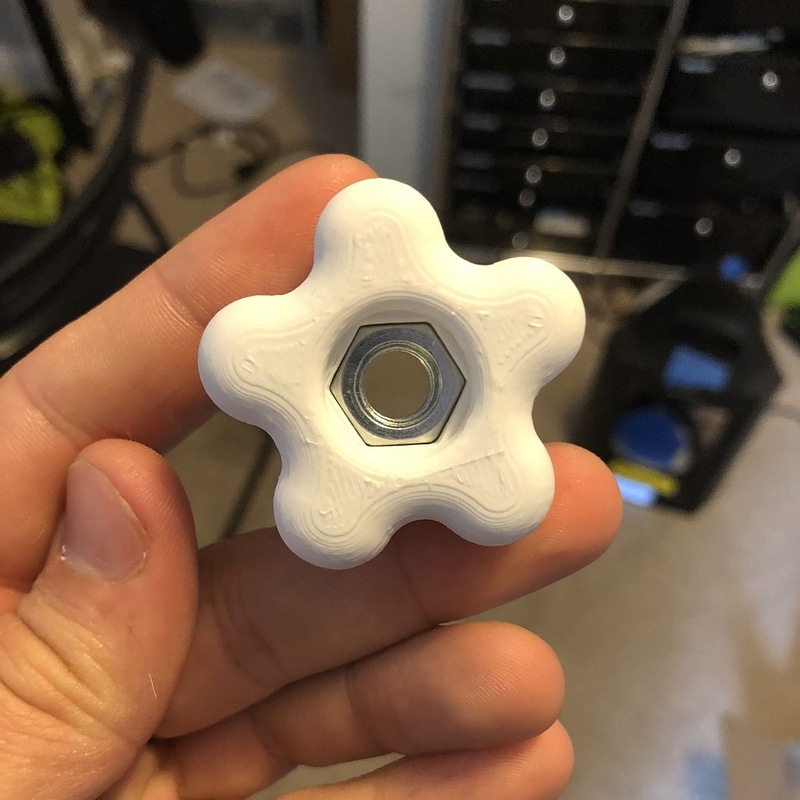
- Star Knobs — Similar to ball knobs, star knobs are usually made of some sort of plastic, metal, or technopolymer. Their unique shape makes them perfect for clamping, as it allows massive force exertion, while their rounded edges allow for comfortable actuation.
Find Industrial Clamping Knobs at Reid Supply
In summary, clamping knobs play a vital role in various clamping applications. If you want to learn more about various types of knobs used in machining or engineering, don’t hesitate to contact our team today who can help you find the product dimensions or application you’re looking for, as well as refer you to the parts with the lowest price or lead time.